We use cookies to provide you with a better experience and ads personalisation. Learn more in our Privacy Policy.
Insights
Approved Document T: What it means for toilet provision in non-domestic buildings
February 25, 2026
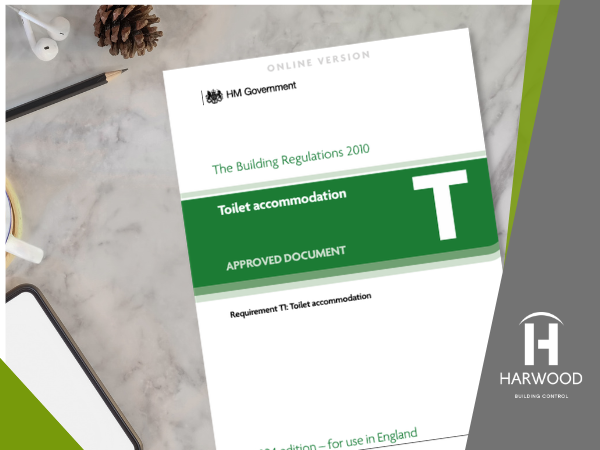
Approved Document T introduces new standards for toilet provision in non-domestic buildings, highlighting the role of designers, developers, and owners in shaping safe, dignified spaces.
This article outlines what Approved Document T covers, when it came into effect, and its practical implications for new buildings and certain building works.
What is Approved Document T?
Approved Document T supports Requirement T1, which was added to Schedule 1 of the Building Regulations 2010. The requirement applies to buildings other than dwellings, with some exclusions including:
- Schools and nurseries
- Care homes
- Ensuite facilities within student accommodation
Part T focuses specifically on toilet provision in workplaces and publicly accessible buildings, to improve privacy, dignity, and safety for building users.
Although it may seem apt, the letter “T” is simply the next available designation within the Building Regulations sequence.
When did the regulations come into force?
Requirement T1 and Approved Document T came into force on 1 October 2024.
They do not apply where, before that date:
- A full plans application, building notice, or initial notice was submitted, and
- Work had started on site and was sufficiently progressed (or became so) within six months of 1 October 2024.
For projects outside these transitional arrangements, Part T compliance is now mandatory.
Why was Part T introduced?
The changes follow extensive consultation and research led by the Department for Levelling Up, Housing and Communities (DLUHC), allowing designers and developers to demonstrate their commitment to high standards and user dignity.
An initial call for evidence launched in 2020 generated over 17,000 responses, an unprecedented level of engagement for Building Regulations. Following further analysis, the government confirmed in July 2022 that it intended to introduce requirements for:
- Separate toilets for men and women
- Optional universal (unisex) toilets, where space allows
- Enhanced privacy standards for any universal provision
What does approved Document T require?
- Single-sex toilet provision (primary requirement)
The default expectation under Part T is that separate toilets must be provided for men and women. These may include:
- Single-sex cubicles with shared single-sex wash hand basins, or
- Toilet cubicles with integrated basins
A key objective is to ensure that people of different sexes are not required to share toilets or washbasins in the same room at the same time.
Importantly, Approved Document T also makes clear that shared wash-hand facilities should not be provided in corridors or open areas outside toilet rooms. Washbasins should be located either in single-sex toilet rooms or in individual universal toilet rooms.
This marks a departure from layouts previously seen in some bars, restaurants, hotels and leisure venues.
- Universal (unisex) toilets – secondary provision
Universal toilets may be provided in addition to single-sex toilets. These must be:
- Fully enclosed rooms or cubicles
- For use by one person at a time
- Fitted with an integral wash hand basin
Where space restrictions genuinely prevent separate male and female toilets, universal toilets may be provided as the sole option. However, Approved Document T does not define “space restrictions”, meaning this must be assessed on a case-by-case basis.
The guidance uses the phrase “where space precludes” the provision of single-sex toilets, meaning designers must evaluate whether sufficient space can be allocated for separate facilities before opting for universal toilets, to ensure clarity in compliance decisions.
In practice, this alternative approach is expected mainly to apply to small buildings, such as compact retail units, small light-industrial premises or similar structures where space constraints are evident, rather than larger developments.
- Wheelchair-accessible unisex toilets
Approved Document T also reinforces the expectation that a wheelchair-accessible unisex toilet should be provided in buildings other than dwellings, in accordance with Approved Document M Volume 2.
Part T does not replace the requirements of Approved Document M; rather, it works alongside them. Designers must therefore ensure that accessible sanitary provision – including wheelchair-accessible unisex toilets and, where required, Changing Places facilities – is addressed in line with Part M.
Privacy, safety and signage
Approved Document T emphasises privacy and safety, reassuring designers and owners that these standards protect building users and promote trust. This includes guidance on:
- Cubicle and room sizing (including ambulant provision)
- Layout and door design
- Clear wayfinding and toilet signage
Compliance with Part T does not remove the need to meet the requirements of:
- Approved Document G (Sanitation, hot water safety and water efficiency)
- Approved Document M Volume 2 (Access to and use of buildings)
- The Workplace (Health, Safety and Welfare) Regulations
- Any relevant sector-specific guidance
All applicable standards must be considered together during design and approval.
A growing suite of regulations
Part T joins several relatively recent additions to the Building Regulations, including Parts Q, R and S, each responding to evolving societal needs, safety expectations, and technological change. It reinforces the government’s intention that building design should reflect both functional performance and user dignity. The latest version of Approved Document T is available here.
How can we help?
Understanding how Approved Document T applies can be complex, but with expert support, designers and owners can be confident they are meeting all required standards. We are here to help you navigate these requirements confidently.
If you would like support in interpreting Part T, or have questions about this or any other existing or upcoming Building Regulations, the team at Harwood Building Control would be pleased to help. Get in touch.